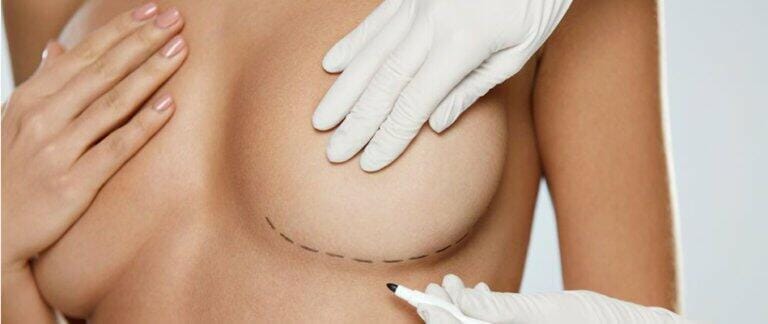

Breast augmentation increases breast size and can change their shape. It can be done with implants or with fat transfer; this article covers implants, while fat transfer is the subject of our companion article on lipofilling. You will learn how implants differ, how surgery is prepared, what recovery usually involves and which risks and check-ups to discuss with your surgeon.
Which implants exist, and from what age?
Two main types are used: saline-filled implants and silicone gel-filled implants. Both have a silicone shell, which can be smooth or textured, and they come in different sizes (FDA). In the United Kingdom, silicone is the most common type (NHS).
Age limits depend on the country and on the device. In the United States, the FDA has approved saline implants for augmentation from 18 years and silicone gel implants from 22 years (FDA). Rules and practices elsewhere may differ, so ask your surgeon which implant and age criteria apply to you.
What does the consultation and preparation involve?
The first consultation usually includes a clinical examination (breast shape, skin quality, asymmetries), a discussion of your medical history and your expectations, and the choice of implant size, shape and placement. Imaging and a blood test are often requested; the exact list is set by your surgeon and anaesthetist. A baseline mammogram may be needed before surgery, depending on your age and history (Mayo Clinic).
Before the operation, your team will give written instructions. Typical points include:
- Smoking: smokers are asked to stop for a period before and after surgery, which can be around 4 to 6 weeks (Mayo Clinic); your surgeon will give the exact period.
- Medicines: aspirin and other drugs that increase bleeding may need to be stopped (Mayo Clinic). Never stop a prescribed treatment without medical advice.
- Skin preparation: follow the washing and fasting instructions you receive.
What is recovery like?
Soreness, swelling and bruising are likely for a few weeks. Timelines vary with the technique and the person; the NHS gives these general markers (NHS):
- no driving for at least 1 week;
- 1 to 2 weeks off work for many people;
- no heavy lifting or strenuous exercise for at least 1 month;
- a supportive or sports bra, which some surgeons advise wearing day and night for up to 3 months;
- most normal activities resumed after about 6 weeks.
Mayo Clinic advises avoiding straining or activities that raise your pulse or blood pressure for at least two weeks (Mayo Clinic). Your surgeon will tell you when you can shower, bathe, swim or expose scars to the sun. Contact the team promptly for fever, redness, warmth, shortness of breath or chest pain.
Do breast implants last a lifetime?
No. The FDA states that breast implants are not lifetime devices: the longer they stay in place, the more likely a removal or replacement operation becomes (FDA). Mayo Clinic gives about 10 years as a typical lifespan, and the NHS notes that further surgery may be needed after about 10 years (NHS). In France, the ANSM also advises considering replacement from about 10 years after implantation (ANSM).
Main complications
- Capsular contracture: scar tissue tightens around the implant, which can make the breast firm, painful or distorted; severe grades may require surgery (FDA).
- Rupture: a tear in the shell. With silicone gel, ruptures are often silent, with no symptoms (FDA).
- Others: infection, pain, changes in nipple or breast sensation and implant displacement (Mayo Clinic).
What is BIA-ALCL, and how is it monitored?
Breast implant-associated anaplastic large cell lymphoma (BIA-ALCL) is an uncommon lymphoma of the immune system that develops in the scar tissue around an implant, not in the breast tissue itself. It has been confirmed mainly with textured implants; estimated frequency ranges from 1 in 3,817 to 1 in 30,000 patients, the average time to diagnosis is about 11 years, and it is often curable when found early (FDA information relayed by the ASPS). Symptoms include unexplained swelling, pain, a lump or a fluid collection around the implant.
In France, the ANSM banned certain macrotextured and polyurethane-coated implants in 2019 and recommends annual medical follow-up for women with implants (ANSM). For silicone implants, the FDA suggests an MRI or ultrasound 5 to 6 years after placement, then every 2 to 3 years, because rupture can be silent (ASPS). Local recommendations may differ, so ask what applies to you.
Mammograms and breastfeeding: what to know
Implants do not prevent breast cancer, so regular screening remains important. Mammography is safe, but tell the technologist about your implants because a different technique and extra views may be needed (NHS). The FDA notes that compression during a mammogram is a possible cause of rupture, and that calcium deposits around an implant can appear on images (FDA).
Breastfeeding: some women breastfeed successfully after augmentation and others cannot (FDA); the NHS notes you may produce slightly less milk (NHS). Discuss your plans with your surgeon before surgery.
When to consult and what to prepare
Consider a consultation if you are thinking about augmentation, or if you already have implants and notice a change in shape, firmness, pain, swelling or asymmetry. Prepare a list of questions and bring your medical history, medicines, any previous imaging and your implant card if you have one.
- Which implant type, surface and placement are proposed, and why?
- What follow-up schedule and imaging do you recommend?
- What are the risks specific to my situation, and what happens if reoperation is needed?
- How should I prepare, and when can I resume work and exercise?
Further reading at La Rose Clinic
Frequently asked questions
Do breast implants need to be replaced?
They are not lifetime devices. Replacement is often considered after about 10 years or sooner if a complication occurs, according to the FDA, NHS and ANSM.
Can I have a mammogram with implants?
Yes. Mammography is safe, but tell the technologist about your implants because extra views or a different technique may be needed.
How long before I can drive and go back to work?
The NHS suggests no driving for at least 1 week and 1 to 2 weeks off work for many people. Your surgeon will confirm for your case.
Can I breastfeed after breast augmentation?
Some women can and some cannot. You may produce slightly less milk, so discuss it with your surgeon beforehand.
Do silicone implants need scans?
The FDA suggests an MRI or ultrasound 5 to 6 years after placement, then every 2 to 3 years. Ask your surgeon which schedule applies locally.
References
- Breast enlargement (NHS) (nhs.uk)
- Types of Breast Implants (FDA) (fda.gov)
- Risks and Complications of Breast Implants (FDA) (fda.gov)
- Breast Implant Safety (ASPS) (plasticsurgery.org)
- New data on breast implant surveillance (ANSM) (ansm.sante.fr)
- Breast augmentation (Mayo Clinic) (mayoclinic.org)
This article is for information only. It does not replace a medical consultation: if in doubt, talk to your doctor.